

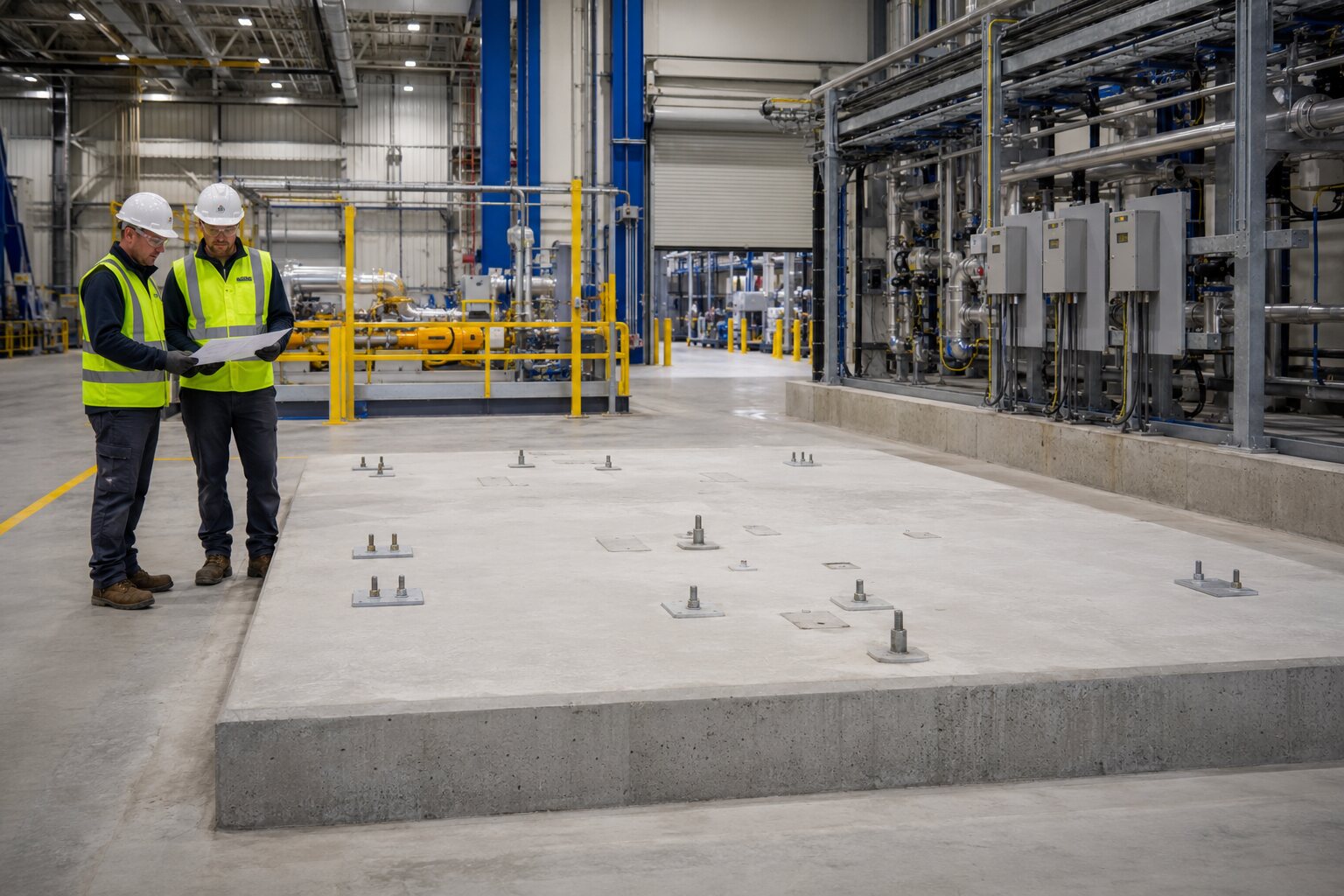
SITE READINESS
New equipment arriving at the plant feels like the start of an installation. In practice, a successful installation begins earlier—with verified drawings, a ready foundation, a measured access route, coordinated utilities, and a clear definition of who owns every handoff.
A machine-installation site-preparation checklist gives facility teams a shared way to confirm those conditions before the truck and installation crew arrive. It also makes unresolved items visible while there is still time to address them.
Confirm the Current Equipment Package
Collect the approved information for the exact machine being delivered. Preliminary sales drawings may not reflect the final configuration, accessories, or shipping splits.
The installation package should include, as applicable:
- Final machine dimensions and shipping dimensions
- Component and shipping weights
- Center-of-gravity and manufacturer-designated lifting information
- Foundation, anchor-bolt, and load data
- Final layout and orientation
- Utility requirements and connection locations
- Assembly, storage, installation, and commissioning instructions
- Shipping list identifying separate cabinets, guards, tooling, and accessories
Record revisions and establish which drawing governs the work. When the OEM, engineer, contractor, and facility teams use different versions, even a correctly executed layout can put the equipment in the wrong place.
Verify the Foundation and Final Footprint
The appropriate owner, engineer, OEM, or other qualified party should confirm that the supporting structure and foundation meet project requirements. The installation team needs a documented release—not an assumption that the concrete “looks ready.”
Before mobilization, verify:
- Foundation dimensions, elevation, condition, and required strength milestone
- Anchor-bolt or insert locations against the approved layout
- Equipment centerlines, benchmarks, and orientation marks
- Pits, trenches, drains, isolation joints, and housekeeping pads
- Required grout, shims, baseplates, soleplates, or leveling devices
- Clearance for doors, guards, service access, product flow, and maintenance
Check the space around the machine as carefully as the footprint itself. A placement can match the drawing and still create a problem if a control-panel door cannot open or a service component cannot be removed.
Walk the Delivery and Installation Route
Measure the route from the public road or facility entrance through final placement. Confirm the actual clear opening after accounting for door hardware, bollards, guardrails, curbs, ramps, canopies, piping, lights, sprinklers, and overhead framing.
The route review should address:
- Truck approach, turning space, staging, and unloading position
- Dock height or ground-level unloading conditions
- Door, aisle, elevator, and corridor clearances
- Floor elevations, slopes, joints, pits, and transitions
- Floor or structural load limitations identified by the responsible party
- Temporary removals and who will complete and restore them
- Production, pedestrian, security, and emergency-access restrictions
If the machine ships in several pieces, map the route and handling method for each major component. RigX’s machine installation services include rigging, setting, leveling, alignment, and related planning for complex industrial equipment.
Make Utilities Ready—but Keep Responsibilities Clear
Identify every required utility and the exact termination point. Depending on the equipment, that may include electrical power, controls, network, compressed air, hydraulic supply, process water, drains, gas, steam, exhaust, ventilation, or fire-protection interfaces.
For each utility, document:
- Design and installation responsibility
- Required capacity, size, pressure, voltage, or connection type
- Location and elevation of the termination
- Whether the connection must be complete before or after setting
- Inspection, testing, and release requirements
- The party authorized to energize or place the system in service
Keep temporary lines and unfinished work out of the move path. Coordinate final connections with the equipment-setting sequence so installers retain the access needed for leveling, anchoring, alignment, and assembly.
Assign Every Trade Handoff
An industrial installation may involve the owner, general contractor, rigger, millwright, electrician, mechanical contractor, OEM technician, controls integrator, engineer, and startup team. Write down where one scope stops and the next begins.
A responsibility matrix can cover unloading, unpacking, inventory, assembly, equipment setting, anchoring, grouting, millwright alignment, utility connection, guarding, lubrication, controls work, calibration, testing, and commissioning.
Also identify who can approve field changes. Waiting for an answer about a misplaced connection or conflicting dimension can consume an installation window quickly.
Define Acceptance Before Setting Day
Installation completion and production acceptance are different milestones. Establish what must be recorded at each stage.
Possible checkpoints include:
- Shipping damage and component inventory review
- Final location, elevation, level, and alignment records
- Anchor and grout completion
- Guarding and access review
- Utility and controls signoff
- Lubrication and pre-start checks
- OEM or owner acceptance
- Dry cycle, test run, or production qualification
- Punch-list ownership and completion dates
OSHA’s general machine requirements state that fixed machinery must be securely anchored to prevent movement and address guarding for machine hazards. The applicable OSHA standard, OEM instructions, engineered documents, and the facility’s own safety program should be evaluated by the responsible parties for the specific installation.
Hold a Final Readiness Review
Before the delivery is released, bring the facility, construction, installation, OEM, and startup leads together. Review open items, drawings, route access, foundation release, utilities, schedule, work permits, staging areas, and contingency plans. Photograph the ready area and document remaining exceptions.
This discipline is especially important in active manufacturing facilities, where an installation must coexist with production traffic and other plant work.
Planning a new machinery installation? Contact RigX with the equipment documents, site drawings, destination photos, and target schedule. The team can help review the rigging, placement, and millwrighting scope before mobilization.
Contact us
Please fill out the form below.