

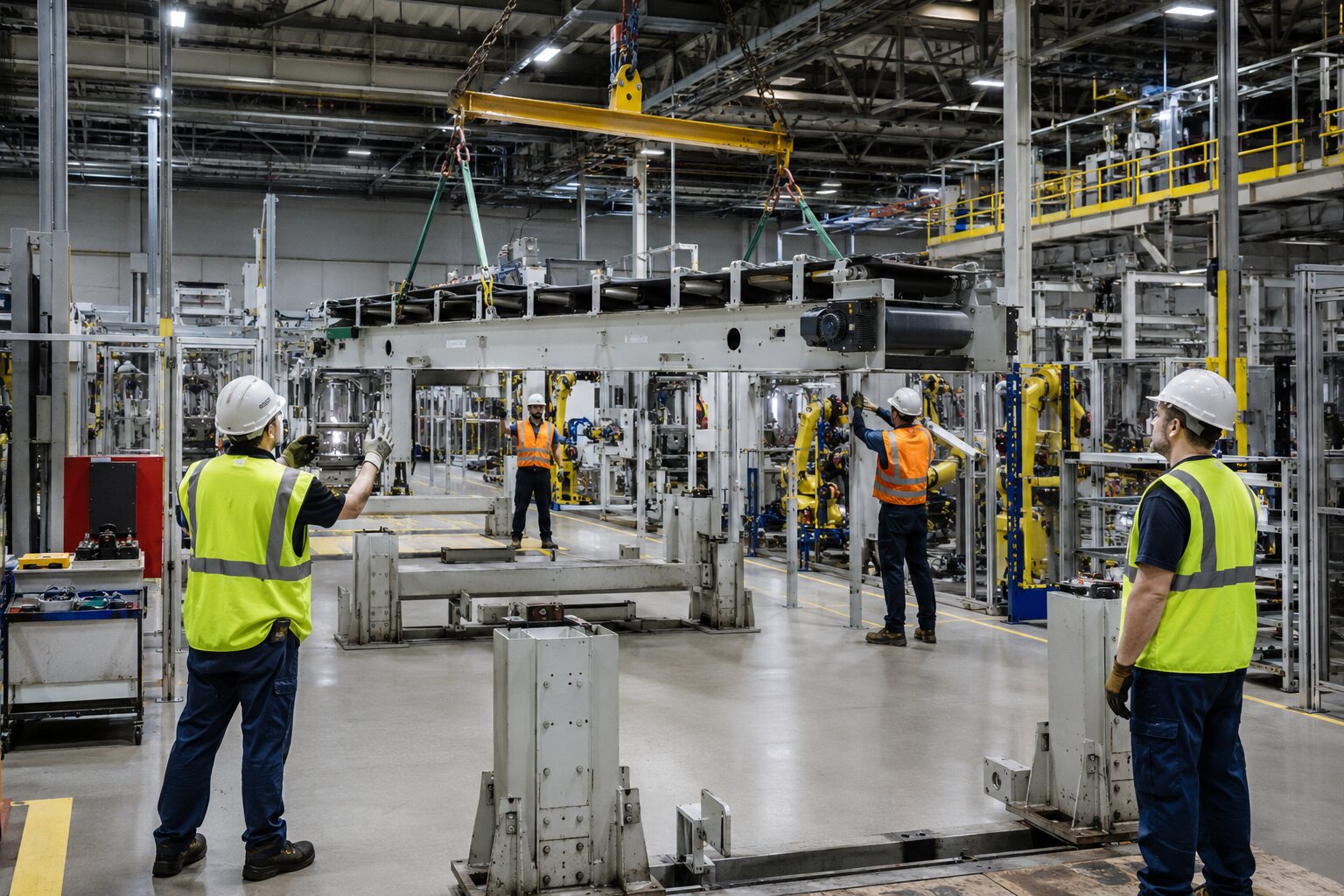
SHUTDOWN PLANNING
A production line reconfiguration may involve only a few machines, but the work touches more than rigging. Equipment must stop in a controlled sequence, utilities must be isolated and disconnected, components must be labeled, move paths must remain open, and each machine must return to the new layout ready for alignment, connection, testing, and production.
The shutdown window is the wrong time to discover that a conveyor section will not clear a doorway or that no one owns the controls changes. Use this production line reconfiguration checklist to build the sequence before work begins.
Define the Current and Future Line
Start with an approved current-state layout and future-state layout. Field-verify both. Legacy plant drawings often omit later modifications, field-routed utilities, guarding, platforms, or nearby equipment.
For each asset, record:
- Asset ID, manufacturer, model, and serial number
- Current and future location and orientation
- Dimensions, weight, center of gravity, and designated lifting points
- Connected conveyors, feeders, platforms, guards, controls, and utility drops
- Parts that must be removed, secured, supported, or protected
- Foundation, anchor, leveling, and alignment requirements
- Required completion and restart sequence
Mark equipment that remains in place. It may need protection from traffic, dust, vibration, or adjacent work even though it is not part of the move.
Build the Shutdown Around Dependencies
A line cannot always be dismantled in the same order it appears on the floor. Upstream and downstream connections, overhead services, shared controls, access limitations, and the future installation sequence may determine what moves first.
Create a logic-based schedule that identifies:
- Last acceptable production run
- Cleaning, product removal, cool-down, or drain-down activities
- Energy isolation and verification
- Electrical, controls, mechanical, and process disconnections
- Rigging and removal sequence
- Foundation or utility modifications
- Equipment placement, assembly, leveling, anchoring, and alignment
- Reconnection, inspection, testing, and release to production
Assign a predecessor and owner to every critical activity. “Electrical complete” is not useful if it does not state which panels, field devices, and tests are included.
OSHA’s control of hazardous energy standard addresses protection from unexpected energization, startup, or stored energy during servicing and maintenance. The facility’s authorized team should establish and manage the site-specific energy-control process and coordination with contractors.
Label Before Anything Is Disconnected
Create a consistent identification system for machines, conveyor sections, guards, cables, hoses, sensors, fasteners, and loose components. Match field labels to the drawings, packing lists, and destination layout.
Photograph connection points and assembly relationships before teardown. Protect labels from cleaning, weather, abrasion, and handling. Store small components in asset-specific containers instead of combining them in a general hardware bin.
Good identification reduces guesswork during reassembly and helps the controls, mechanical, and OEM teams confirm that the correct components returned to the correct location.
Confirm Move Paths and Staging Areas
Walk the route for every major asset and the rigging equipment needed to handle it. Measure clear openings, turns, overhead conditions, slopes, floor transitions, and temporary removals. Confirm where each asset can be staged without blocking exits, production, other trades, or the next move.
The route plan should cover:
- Equipment movement from current position to staging or final position
- Scrap, demolished components, crates, tools, and waste flow
- Forklift, crane, truck, and personnel access
- Protection for floors, walls, doors, utilities, and equipment that remains
- Barriers and controls for the active work zone
- A recovery route if an asset cannot be placed as planned
For complex industrial machine moving, build the sequence around both the destination layout and the physical space required to execute each move.
Coordinate Rigging and Millwrighting as One Sequence
Final placement is not automatically final installation. Define the required location, elevation, level, anchor condition, and alignment for every asset. Identify which checks must occur before the rigging equipment can be released and which happen after adjacent components are installed.
Production lines may require alignment across conveyors, shafts, rolls, gearboxes, feeders, or process equipment. Coordinating millwright services with equipment movement helps preserve access and prevents premature connections from blocking precision work.
Record baseline measurements before disassembly when they will help the owner, OEM, or installation team evaluate the new setup. Use the approved project and manufacturer tolerances rather than assuming the previous condition is the correct target.
Manage Trade Handoffs in the Field
Use a responsibility matrix and daily coordination meeting to track areas released for work. The owner, rigger, millwright, electrician, mechanical contractor, controls integrator, OEM, and startup lead should know who can declare an activity complete and who accepts the handoff.
Useful hold points include:
- Equipment safe and released for disconnection
- Asset mechanically ready to move
- Route and destination released for rigging
- Machine set and accepted for anchoring or connection
- Alignment accepted
- Utilities and controls complete
- Guarding and access restored
- Area released for testing
Do not hide unresolved work inside a general “punch list.” Assign each item an owner, required completion time, and effect on restart.
Plan the Restart Before the Shutdown
Define the restart sequence, acceptance criteria, and decision authority in advance. The plan may include mechanical inspection, lubrication, guarding, utility checks, controls validation, dry cycling, OEM review, trial production, and quality approval.
Protect time for testing and correction. If every available hour is allocated to moving and reconnecting equipment, the first unexpected adjustment can consume the restart margin.
Also identify the fallback plan. Decide which incomplete items prevent operation, which can be completed after restart, and who has authority to change the sequence.
Give the Team One Source of Truth
Keep the current schedule, drawings, asset list, action log, responsibility matrix, and contact list available to everyone managing the shutdown. Record field changes as they occur so the restart team is not working from an outdated plan.
RigX supports manufacturing facilities with equipment moving, installation, alignment, and line-reconfiguration work. To discuss an upcoming shutdown, contact RigX with the current and future layouts, equipment list, shutdown window, photos, and known trade responsibilities.
Contact us
Please fill out the form below.