

EQUIPMENT LOGISTICS
Capital equipment does not always arrive when a facility is ready to receive it. Construction may be incomplete, utilities may be delayed, an OEM shipment may be early, or a plant move may require equipment to leave the old building before the new production area is available.
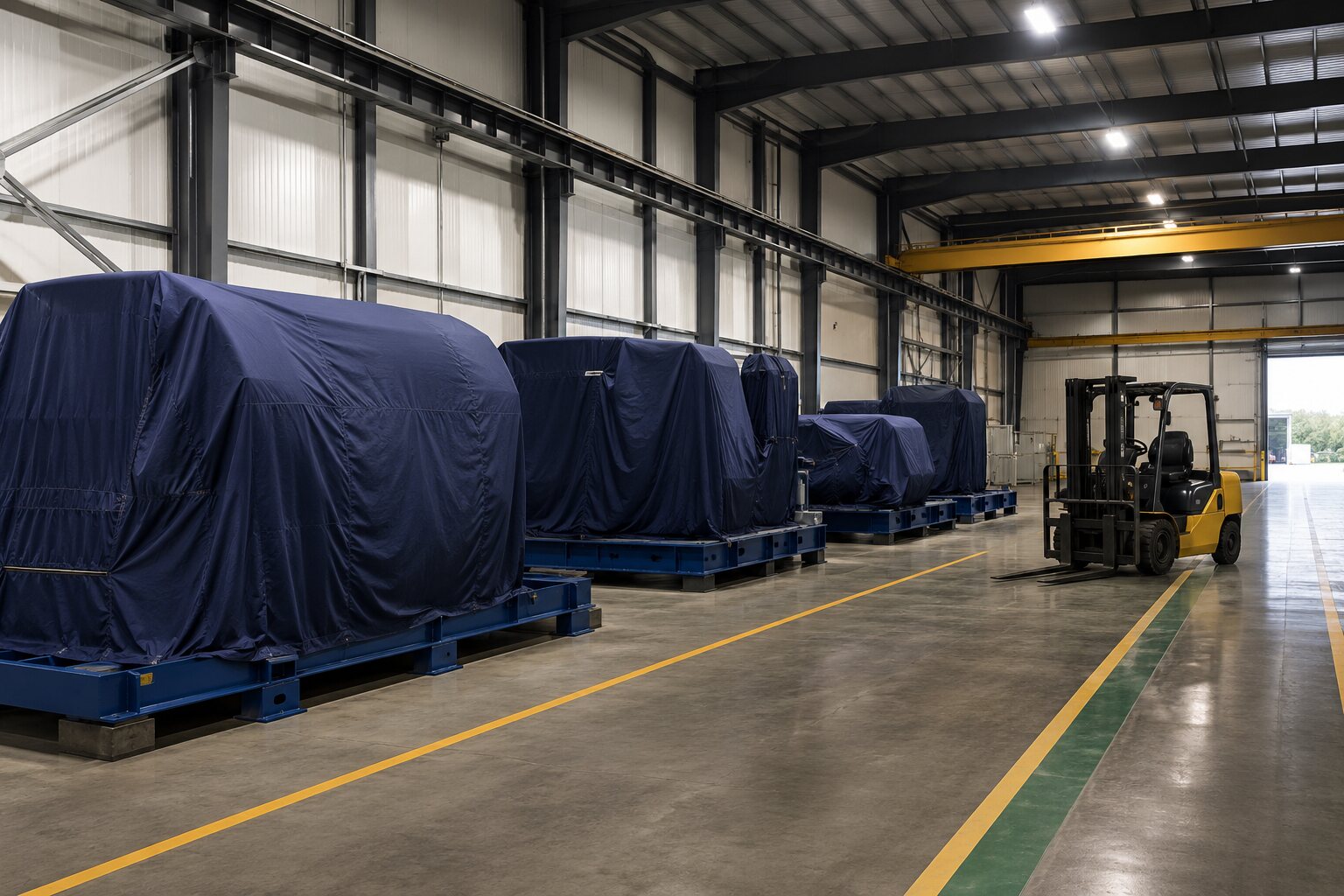
In those situations, industrial equipment storage should be planned as an active phase of the project. The goal is not simply to place machinery indoors. The goal is to preserve its condition, maintain clear custody and inventory records, and release each asset in the sequence the installation team needs.
Decide What Storage Must Accomplish
Start with the reason for storage and the expected release condition. A short staging period before installation has different requirements from long-term storage of idle equipment.
Define:
- Expected arrival and release dates
- Whether the dates are firm or dependent on construction milestones
- Indoor, outdoor, temperature, humidity, and contamination constraints
- Whether equipment will arrive assembled, disassembled, crated, or containerized
- Required access for inspection, preservation, testing, or OEM work
- The condition in which each asset must leave storage
The equipment manufacturer’s storage instructions should guide environmental and preservation requirements. Identify special needs before the asset arrives, not after it has been placed in a crowded warehouse.
Build an Asset-Level Intake Plan
Every stored item should connect to a project record. Before delivery, prepare an asset list with the manufacturer, model, serial number, purchase order or project number, dimensions, weight, lifting points, and packaging type.
At intake, document:
- Arrival date, carrier, and shipping reference
- Visible packaging and equipment condition
- Shock, tilt, or environmental indicators when supplied
- Loose components, accessories, tooling, manuals, and control cabinets
- Photos from multiple sides before and after unloading
- Storage position and identification method
- Exceptions that require owner, carrier, supplier, or OEM review
Small components deserve the same discipline as the main machine. A missing sensor package, fastener kit, guard, or control component can delay an otherwise complete installation.
Match Handling Methods to the Equipment
Storage planning begins before unloading. Confirm how the equipment can be lifted or moved, whether shipping braces must remain installed, and whether the package can support stacking. Never treat a crate as stackable unless its design and documentation say so.
The receiving plan should account for trailer type, dock conditions, overhead clearance, floor conditions, and the material-handling equipment needed to transfer the asset into storage. If a machine will require specialized rigging again at release, place it where that work can occur without moving unrelated assets first.
RigX’s industrial equipment warehousing and storage services can be coordinated with receiving, unloading, handling, and future deployment. Project-specific facility and environmental requirements should still be confirmed during planning.
Establish a Preservation Program
Preservation is specific to the equipment and the storage duration. Follow the approved manufacturer or owner requirements for tasks such as corrosion protection, lubrication, shaft rotation, desiccant replacement, battery care, climate monitoring, fluid management, or packaging inspection.
For each required task, record:
- The procedure and its source
- Who is authorized to perform it
- Required frequency
- Completion date and observations
- Any condition that needs escalation
Avoid improvised preservation steps. Removing a shipping brace, opening sealed packaging, rotating a component, or energizing a system may have consequences if it conflicts with OEM instructions or warranty conditions.
Stage Equipment in Installation Sequence
The easiest item to place in storage is not always the first item that should be released. Coordinate the warehouse layout with the installation plan.
Group or position assets according to:
- Building, floor, room, line, or work cell
- Installation phase and required-on-site date
- Final placement sequence
- Shared-load or shared-trailer opportunities
- Special handling or escort requirements
- Need for preassembly, inspection, or preparation before shipment
For a multi-phase plant relocation, the warehouse can function as a controlled buffer between decommissioning and installation. A clear sequence reduces extra handling and helps keep the destination from becoming an uncontrolled laydown area.
Plan the Release Before the Equipment Arrives
Do not wait until the installation crew is mobilized to decide how assets leave storage. Establish a release process with notice requirements, authorization, delivery contacts, site hours, truck access, and documentation.
Before each release, confirm:
- The destination is ready to receive the equipment
- The correct asset and all associated components are included
- Preservation and condition records are current
- Packaging or shipping braces are suitable for transport
- Delivery order matches the installation sequence
- The receiving crew, rigging equipment, and laydown area are ready
Connecting storage to machine installation planning turns warehousing into a scheduling tool. It gives the project team a controlled way to absorb supplier and construction variability without losing track of equipment readiness.
Make Storage Part of the Project Schedule
Include intake, inspection, preservation, preparation, release, transportation, and final setting as visible schedule activities. Assign ownership for each handoff and keep the asset register current as equipment moves.
If your project needs storage between delivery, relocation, and installation, contact RigX with the equipment list, storage duration, handling requirements, and anticipated release sequence. The earlier those requirements are defined, the easier it is to build warehousing into the overall move plan.
Contact us
Please fill out the form below.